Financial Consistency
Helped validate that financial balances in the legacy system were consistent with corresponding results after migration.
How I worked with an enterprise hospitality client and engineering teams to translate legacy data migration requirements into an ETL solution, with a focus on data integrity, financial consistency, and reporting accuracy.
An enterprise hospitality client needed to migrate historical hotel and guest data from a legacy Property Management System (PMS) into the HotelKey platform.
The source data was provided in large, compressed XML files. The information needed to be analysed, mapped to the target system's data structure, transformed, and loaded into the new platform.
A successful migration required more than transferring records. Financial balances needed to remain consistent, and reports needed to reflect the migrated data correctly.
Help define and deliver a repeatable ETL process that could migrate the required client data while maintaining data integrity and improving confidence in financial and reporting results.
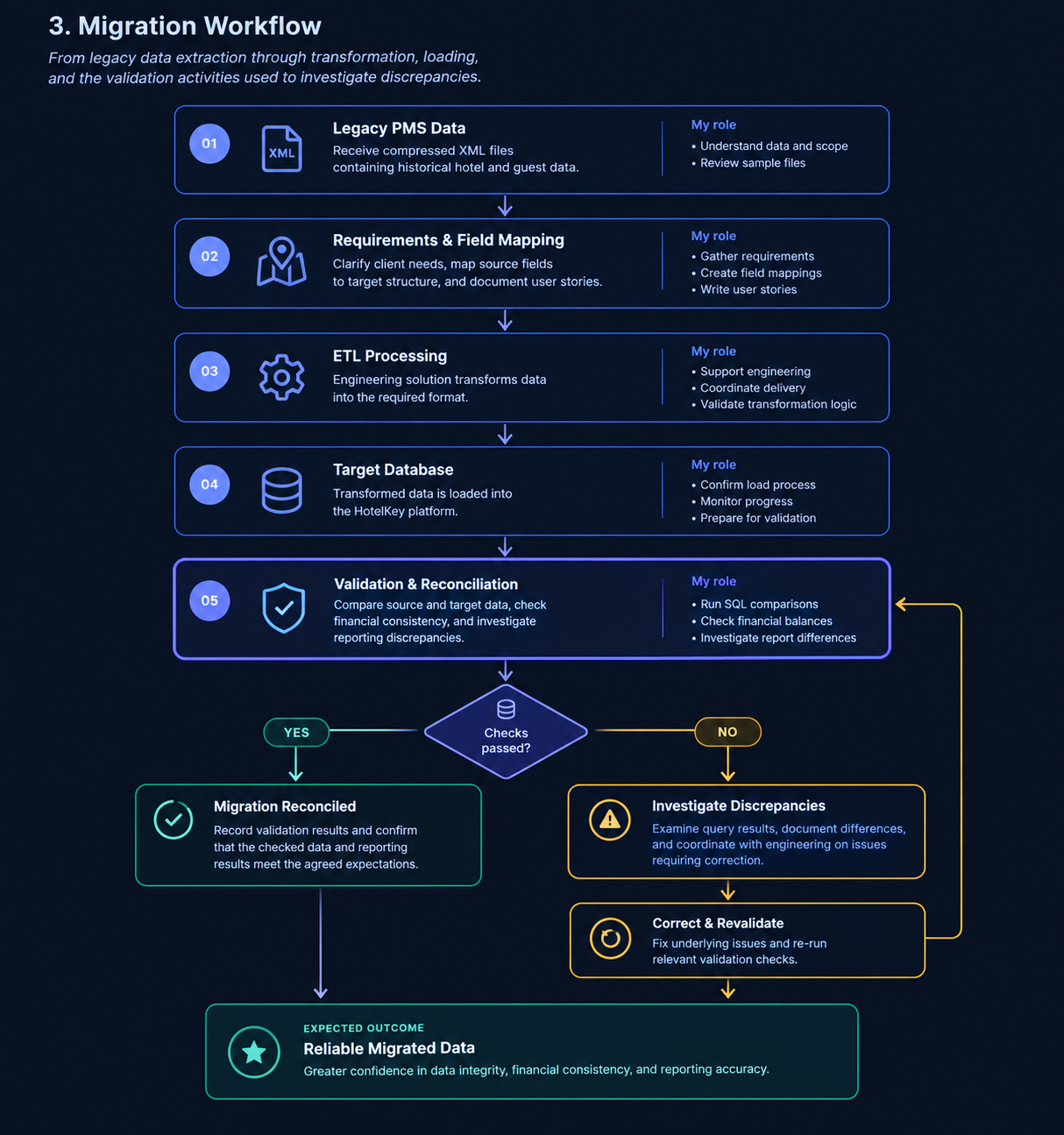
This workflow illustrates how legacy hospitality data moved through requirements analysis, ETL processing, and validation. It also shows how discrepancies were investigated and validation repeated when needed.
Select each stage to see its purpose and the product delivery activities associated with it.
Understand the client's migration needs, review representative source data, and clarify the information that must be available in the target system.
Expand each area to see how I contributed to requirements, implementation coordination, and data quality.
An important part of the project was checking that migrated information remained meaningful to the business. Data could be present in the new system but still produce incorrect financial or reporting results.
Helped validate that financial balances in the legacy system were consistent with corresponding results after migration.
Used queries and product knowledge to compare source and target data, investigate differences, and check whether reports reflected expected results.
Initial validation involved analysing sample data and comparing source and target results. SQL queries and troubleshooting helped identify discrepancies that required further investigation.
The engineering team subsequently automated validation steps. The ETL solution also generates discrepancy reports that help identify reporting differences and support bug investigation.
I remain loosely involved in troubleshooting when needed. Validation therefore continues to support ongoing data and reporting issue investigation beyond the initial migration work.
Review sample data, run queries, compare source and target results, and investigate identified differences.
Engineering automated validation steps, and the solution generates discrepancy reports to support further investigation.
This comparison describes the evolution of the validation process. It does not imply a measured reduction in effort or a quantified improvement.
Contributed to delivery of an ETL capability that processes client migration files and loads transformed data into the target system.
Helped establish validation practices for checking migrated data against expected results.
Supported financial consistency checks and reporting reconciliation during migration.
Contributed to validation and troubleshooting practices that support discrepancy investigation.
Helped connect client business requirements with engineering implementation and ongoing product quality.
No numerical improvement is claimed because verified performance measurements have not been established for publication.
My focus was on connecting the client's business requirements with the engineering team's implementation. This involved understanding the source data, documenting the required mappings, validating the resulting data, and helping ensure that financial and reporting expectations were addressed.
This project reflects my approach to product delivery: clarify the business need, translate it into actionable requirements, collaborate with technical teams, validate outcomes, and use identified issues to improve the product.